5 min read
YNAB alternatives in NZ (and when SortMe is the better fit)

Article by
Carl Thompson · CEO and Co-founder of SortMe
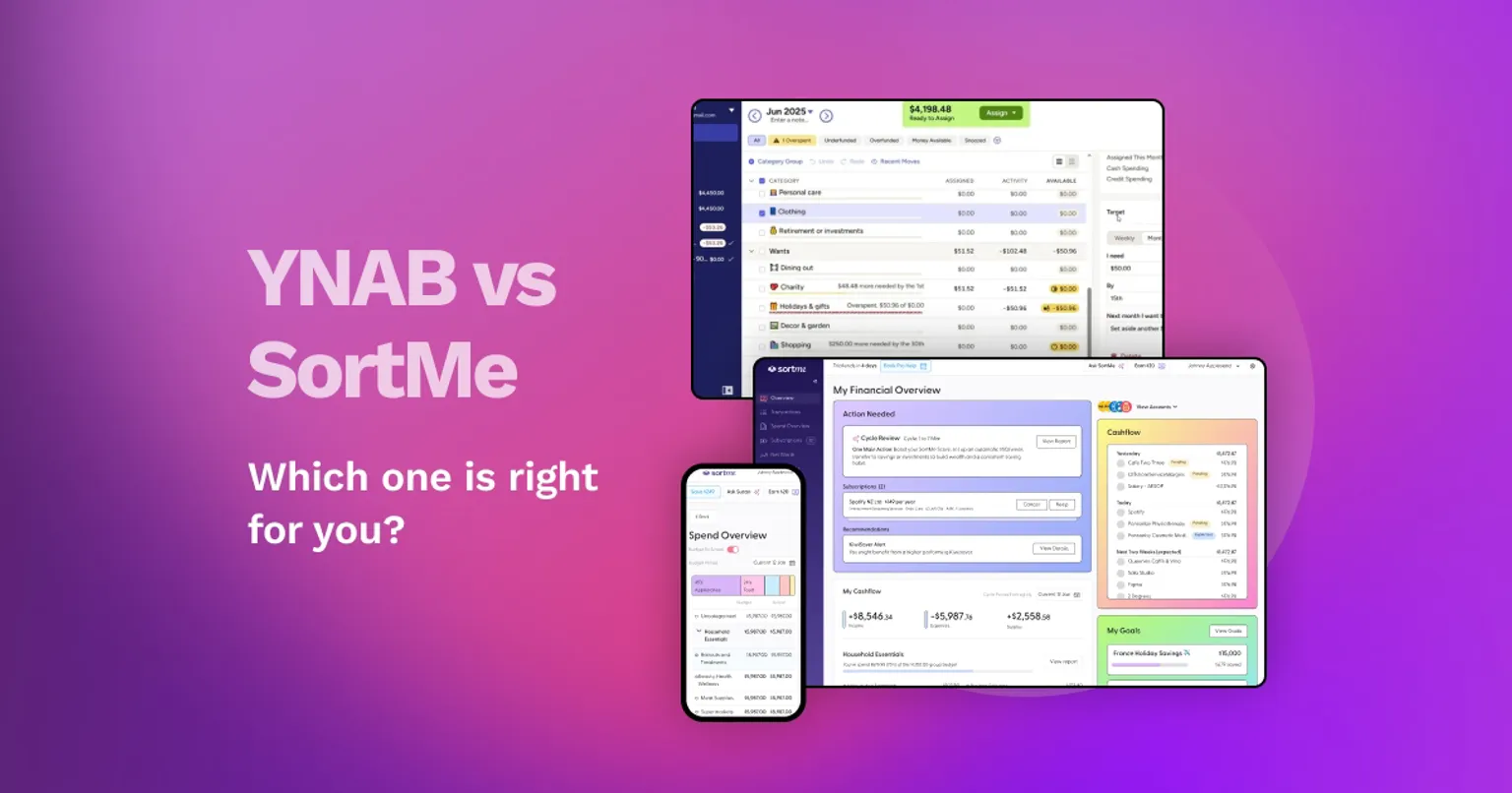
For Kiwis who've fallen down the budgeting rabbit hole, YNAB (You Need A Budget) is often the name that comes up — and then the question becomes whether it actually works in New Zealand. YNAB and SortMe both go well beyond a bank app, but they come at money from two very different angles.
- YNAB is a method first and an app second. It's built around zero-based budgeting and a strict set of rules you follow.
- SortMe is an AI financial assistant in your pocket, built in NZ to do the heavy lifting for you.
I'm Carl Thompson, founder and CEO of SortMe — so let me declare my interest upfront, and be honest with you. YNAB has earned a genuinely loyal following over twenty-odd years, and for good reason: the method works for the people who stick with it. But it's an American product built around an American way of budgeting, and that shows up the moment you try to run it on NZ bank accounts. This piece is here to help you work out which approach actually fits you.
Here's the honest comparison: where YNAB wins, where SortMe wins, and the main question to help you pick one.
The bigger difference: a method you follow vs an assistant that does it for you
The feature comparisons matter, but the deeper difference between YNAB and SortMe is what kind of product each one is trying to be.
YNAB is, at its core, a budgeting philosophy. It's built around zero-based budgeting — the idea that you give every dollar a job before you spend it, so your income minus your assignments equals zero. It's backed by YNAB's "Four Rules", and the whole experience is designed to make you sit down, assign every dollar, and rebalance when life doesn't go to plan. For people who want that structure and are happy to do the work, it genuinely changes behaviour.
SortMe is built to be an AI financial assistant in your pocket. We designed it to take the workload off you — to handle the categorisation, spot the patterns, flag the decision moments, and tell you what's actually worth your attention. It works with you rather than asking you to follow a rulebook. We call this next-gen software: AI-powered, automated, and hyper-personalised to your specific situation.
Both approaches are legitimate — but they're built for very different households.
What YNAB is strong at
A proven method. Zero-based budgeting is YNAB's whole identity, and it's effective. "Give every dollar a job", planning for your true expenses, and aging your money are real habits that help people break the paycheck-to-paycheck cycle. If you want a system with strong opinions, YNAB has them.
Behaviour change, not just reporting. YNAB is less about looking back at where your money went and more about deciding, up front, where it's going to go. For people who overspend and want friction in the system, that intentionality is the point.
A strong community and education. Two decades in, YNAB has excellent guides, workshops, and a committed user base. There's no shortage of help learning the method.
Hands-on control. Every dollar is assigned by you, to a category you chose. If you like owning every line of your budget and rebalancing it yourself, YNAB gives you that control.
Where we built SortMe differently
Built for NZ banks, not bolted on. This is the big one. YNAB has no direct connection to major NZ banks — ANZ, ASB, BNZ, Westpac, Kiwibank — so most Kiwi users end up importing CSV files by hand or paying for a third-party workaround to sync transactions. SortMe connects to NZ banks and KiwiSaver providers directly through Akahu, New Zealand's open-banking platform, and categorises everything automatically.
Less restrictive by design. Zero-based budgeting asks you to account for every dollar and shuffle money between envelopes when you overspend in one category. It works, but it's a lot of manual upkeep. SortMe leads with cashflow — the "can I actually afford this on a Tuesday" view — so you stay across your money without rebalancing a spreadsheet of categories every week.
AI-powered insights. No generic data. Our Cycle Reviews give you an AI-powered, personalised overview of your cashflow: the good, the bad, and the one main thing you could do that would make a meaningful difference.
Automatic categorisation and history. Once you connect your accounts, SortMe categorises your transactions for you — going back 12 months or more, depending on your bank — so you get insight in minutes rather than data entry every day.
Priced in dollars that make sense here. YNAB bills in US dollars, so the price moves with the exchange rate and you can cop foreign transaction fees on top. SortMe is built and priced for New Zealand.
Surfacing risks and opportunities. When SortMe spots a pattern worth flagging — a KiwiSaver fund mismatch, cashflow drift, an upcoming mortgage refix date — the app surfaces it, and can match you with one of our licensed financial advisor partners.
Subscription and recurring-charge audit. Our Subscription Tracker is a dedicated feature designed to help you identify and cancel unused subscriptions. On average, users cancel $2,371 in annual charges they'd forgotten.
The question to help you decide
Question: Do you want to run a budgeting system, or have an assistant run alongside you?
If you love the discipline of assigning every dollar a job, you want strong rules to follow, and you don't mind importing your NZ transactions by hand, YNAB's method is a good fit. If you'd rather connect your NZ accounts in a couple of taps and have an automated AI assistant guide you to better money management, SortMe's your product.
Both are legitimate answers. Different households, different products.
Pricing
YNAB:
- No free tier (34-day free trial)
- One plan: around US$14.99/month or US$109/year, billed in US dollars
- For NZ users, the real cost moves with the exchange rate, and your card may add a foreign transaction fee on top
SortMe:
- Boost: $99/year or $29/month — full Cashflow Health Score, forecasting, rollover budgets, proactive AI insights, advisor/broker pathway
- SortMe's heavy discount for an annual subscription works out to be $8.25 a month. Being the best deal.
Switching from YNAB
There's no real lock-in either way. The catch with YNAB in NZ is that getting your transactions in often meant manual CSV imports or a third-party sync tool in the first place, so there's not much to untangle.
With SortMe, you connect your bank and KiwiSaver accounts directly through Akahu, and it automatically categorises your transactions — going back 12 months or more, depending on your bank. Categorisation takes a few minutes, and after that you'll have full insight into your historical spend as well as your forecasts. No envelopes to rebuild, no CSVs to wrangle. Easy as that.
The practical next step
Try both out and compare for yourself. Start your SortMe trial at sortme.com
Sources
- The YNAB Method, YNAB — ynab.com/ynab-method
- Pricing, YNAB — ynab.com/pricing
- Linked Accounts in YNAB, YNAB Support — support.ynab.com
- Akahu — New Zealand's Open Banking Platform, Akahu — akahu.nz