5 min read
Let's make Christmas easier on the wallet. Our free Christmas Budget Planner is now live.

Article by
Hugo Jonston · Resident Money Writer
Christmas is meant to be a joyful time of year, but it’s easy for the money side to get in the way. In a survey before last Christmas, nearly two-thirds of New Zealanders said they felt some level of financial stress about it(1).
Part of the problem is that most households haven’t planned for Christmas. Spending is split across gifts, food, travel, and events; it runs from November into January, and it comes out of several accounts, usually a credit card as well.
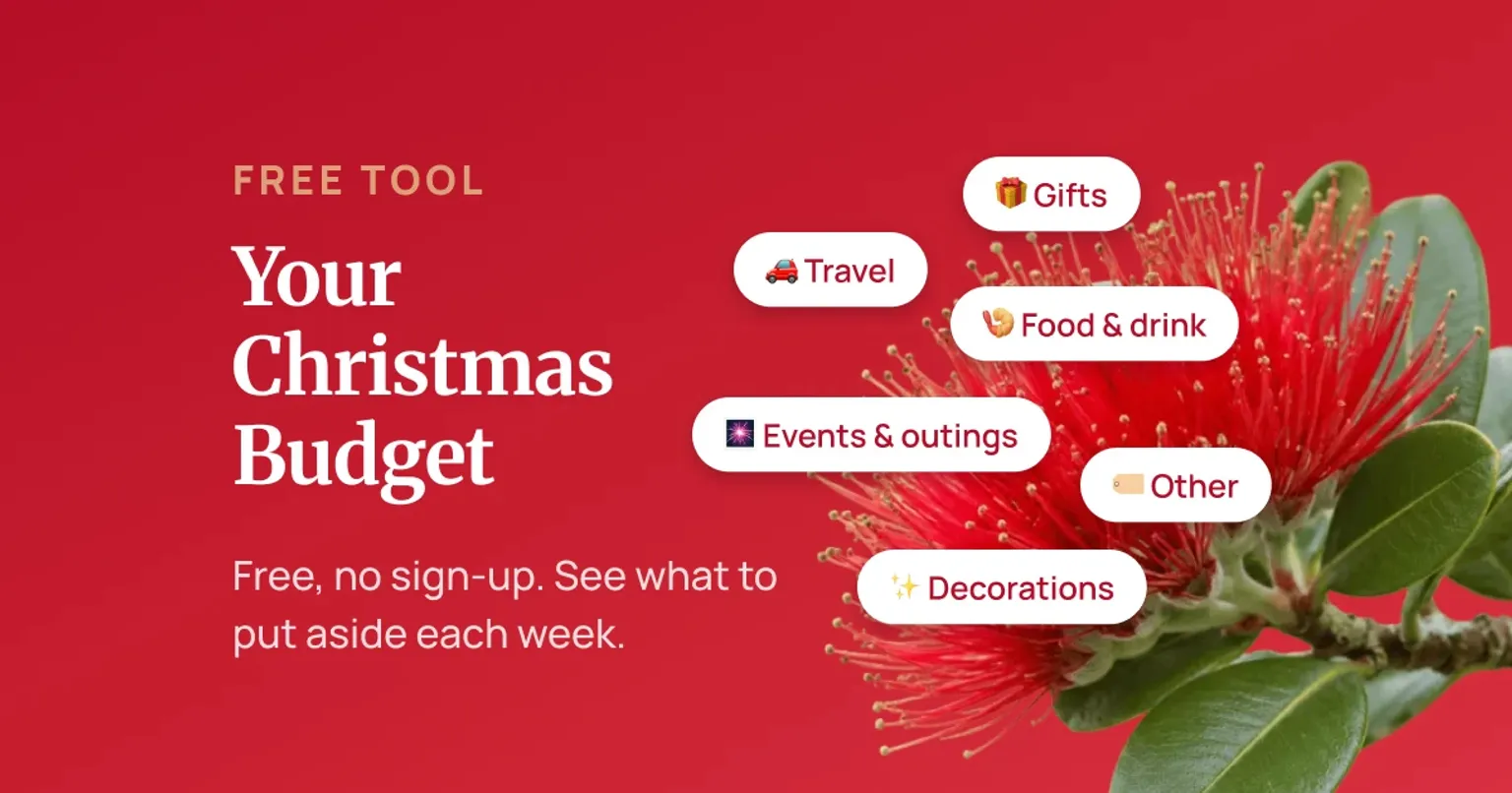
We’ve built a free Christmas Budget Planner to help.
It guides you through the expenses of Christmas. You type in what you expect to spend under each section, and it gives you the total and the amount to put aside each week or fortnight. There’s no sign-up, and it includes things you might not have thought about otherwise.
What the planner does
The planner takes you through six sections, one at a time:
- Gifts. A line for each person and the amount you plan to spend on them.
- Food and drink. The Christmas Day meal, the drinks, and the extra groceries while everyone is home.
- Travel. Flights, petrol, the ferry and accommodation if Christmas is out of town.
- Events and outings. Work functions, end-of-year dinners and summer days out.
- Decorations. The tree, lights, wrapping paper and cards.
- Other. Anything specific to your household, such as pet boarding.
A running total stays at the top of the page as you move through the sections.
The summary at the end tells you what Christmas will cost and how much to put aside each week or fortnight to have it ready by 24 December. You can change that date, and if you’ve already saved something, the planner takes it off before it does the division.
The presents are often the smaller share
When people estimate Christmas, they usually count the presents and the Christmas Day meal. In the same survey, New Zealanders expected to spend about $415 on food and drink over Christmas and New Year, against about $140 a head on presents(1).
Travel, the end-of-year events and the decorations come on top of both. A household that budgets only for presents and the main meal will certainly be underestimating the real total, which is why the planner gives each of those costs its own section.
Get your number before Black Friday
Black Friday is 27 November. Last year Consumer NZ tracked 10 products at four big retailers for 14 weeks, and half of them had been the same price or cheaper at some point before the sale(2).
A sale price only helps if the item was already on your list. If you have your total and your gift lines written down before the 27th, you can measure each deal against them and leave the rest.
You can also hand the price checking to an AI assistant such as Claude or Grok. Give it your gift list with a link to each product, and set up a scheduled task that checks the prices once a week and tells you when one drops, so you can buy each gift when it’s cheapest in the weeks before Christmas.
Share it with whoever is paying for Christmas with you
For household finances to work, both partners need to be on the same page, and Christmas is no different. The planner gives you a read-only link to send to your partner, and their view updates whenever you change the plan.
The plan itself is saved in your browser, on the device you made it on. If you want to keep it somewhere else, you can email yourself a copy.
If the weekly amount doesn’t fit
For some households the weekly figure will be more than the budget can find. I’d cut the list before I’d put the difference on a credit card. A Secret Santa for the adults, a dollar limit on presents and an agreement about who brings what on the day will all take real money off the total, and those conversations are easier to have early.
A card is fine for convenience when the balance is cleared in full by the January due date. Anything still owing after that date starts to collect interest, and it arrives in the same few weeks as the back-to-school costs.
Where SortMe comes in
The planner works from the numbers you type in, and SortMe works from your real transactions. Once your accounts are connected, you can add a tag such as Xmas26 to each Christmas purchase, on any account or credit card, and see one running total to compare with your plan.
The Cashflow Forecast also shows where the expenses land, so you can see whether the December card statement and the school costs will be covered. Add your one-off Christmas costs to the forecast and you’ll see what they do to your cash on hand in the weeks after.
You can try SortMe for $1 for 7 days (after that, the plan price applies unless you cancel).
What to do this week
Open the Christmas Budget Planner, fill in the six sections, and enter anything you’ve already put aside. Send the link to your partner so you’re both working from the same total.
Then set an automatic payment for the weekly amount, timed for the day after your next pay. Each week you wait leaves one less pay to spread the total across, so the weekly amount goes up.
For the longer version, including how to find last year’s number from your bank statements, read How to plan for Christmas in NZ without the January debt.
This is general information, not personalised financial advice, and SortMe isn’t a financial adviser. If Christmas is arriving on top of debt you’re already struggling to keep up with, MoneyTalks is free and confidential.
Sources
- MYOB consumer poll of 1,000+ New Zealand adults, November 2025. The financial stress figure and the $140 a head gift figure are as reported in NZ Adviser, Households hopeful for 2026 but Christmas budgets tight, 20 November 2025 — mpamag.com. The $415 food and drink figure is as reported by RNZ, Many households likely turning to debt to pay for this year’s presents, 19 November 2025 — rnz.co.nz
- Consumer NZ, Consumer NZ’s 3-month study finds many products were cheaper before Black Friday, November 2025 — consumer.org.nz