8 min read
Index funds vs picking stocks in NZ: fewer than 1 in 5 pros beat the index

Article by
Hugo Jonston · Resident Money Writer
Buying a single company's shares on your phone feels like investing. The app is clean, the ticker goes green, and you tell yourself you've done your homework on this one. It feels like skill.
Here's the uncomfortable part. The people who do this for a living, fund managers with Bloomberg terminals, research teams and decades of experience, mostly lose to a simple index fund. In the index funds vs picking stocks contest, the professionals have been measured every year for 24 years, and the index keeps winning(1). If they can't beat it, the odds that you will, picking them yourself on Sharesies or Tiger Brokers, are poor.
That result is one of the most replicated findings in finance, and SortMe sees the fallout in real households' balances. This article walks through the numbers: how often the professionals beat the market, why the few who manage it are mostly lucky, and what the evidence says about the best way to grow your money over the long run.
Index funds vs picking stocks: the professionals' scoreboard
Every year, S&P Dow Jones Indices publishes the SPIVA Scorecard, which measures actively managed funds against the index they're trying to beat. The Year-End 2024 results, the most recent full year, are blunt(1). Over one year, 65 percent of US large-cap funds underperformed the S&P 500. Stretch the timeframe and the picture deteriorates: over 10 years, 84 percent of professional managers came up short, and over 15 years, 89.5 percent did.
Put the other way around, fewer than 1 in 5 professionals beat a fund that buys the whole market and sits there over a decade, and barely 1 in 10 stay ahead over 15 years. The longer you measure, the fewer survive.
Yes, some of them win. That's the trap.
A few managers do beat the index, and the question is whether that comes from skill or luck. The research here comes from the most decorated names in the field, and it is brutal.
William Sharpe, who won the Nobel Prize in economics, laid out the maths in The Arithmetic of Active Management(2). Before costs, all the active investors together simply are the market, so on average they match it, and after fees and trading costs they have to lag it. As a group, active managers cannot beat the index after costs. Some individuals will, but only by the same amount others lose, and you would have to pick those winners in advance.
Eugene Fama, another Nobel laureate, and Kenneth French tested whether anyone reliably can. Their study Luck versus Skill in the Cross-Section of Mutual Fund Returns went through decades of fund records and found that once you account for costs, the number of managers with demonstrable, repeatable skill is tiny, and the winners look close to indistinguishable from people who got lucky(3).
Luck also runs out. S&P's Persistence Scorecard tracks whether today's top funds stay on top, and a recent run found that of the US funds ranked in the top quartile in 2020, not one was still there four years later(4). Past performance does not predict future results, and the disclaimer means it.
Underneath all of this sits the insight that won Fama his Nobel in the first place: in a liquid market, a share's price already reflects the publicly available information about the company(5). The earnings report you read this morning, the analyst note, the story in the Herald: the market read them before you did and moved the price accordingly. That leaves a stock picker with two possible edges. One is information the public doesn't have, and trading on that is illegal in New Zealand under the Financial Markets Conduct Act(5). The other is a guess about a future nobody knows yet, and staking money on a guess is gambling by definition, however sophisticated the app makes it feel.
So when you buy an individual share because a fund did well, or a forum was loud, or the float was the hottest thing on the market, you're betting that past results will repeat, and the evidence above says they don't.
Individual investors do worse than the pros
If the professionals struggle, ordinary people picking their own shares do worse. The most famous study here, by Brad Barber and Terrance Odean, carries a title that gives away the conclusion: Trading Is Hazardous to Your Wealth(6). Tracking tens of thousands of individual investors, they found the ones who traded the most earned the lowest returns, and the damage went beyond fees: people sold the shares that went on to do well and bought the ones that didn't. A later study of day traders by the same team found fewer than 1 percent made money predictably after costs(7).
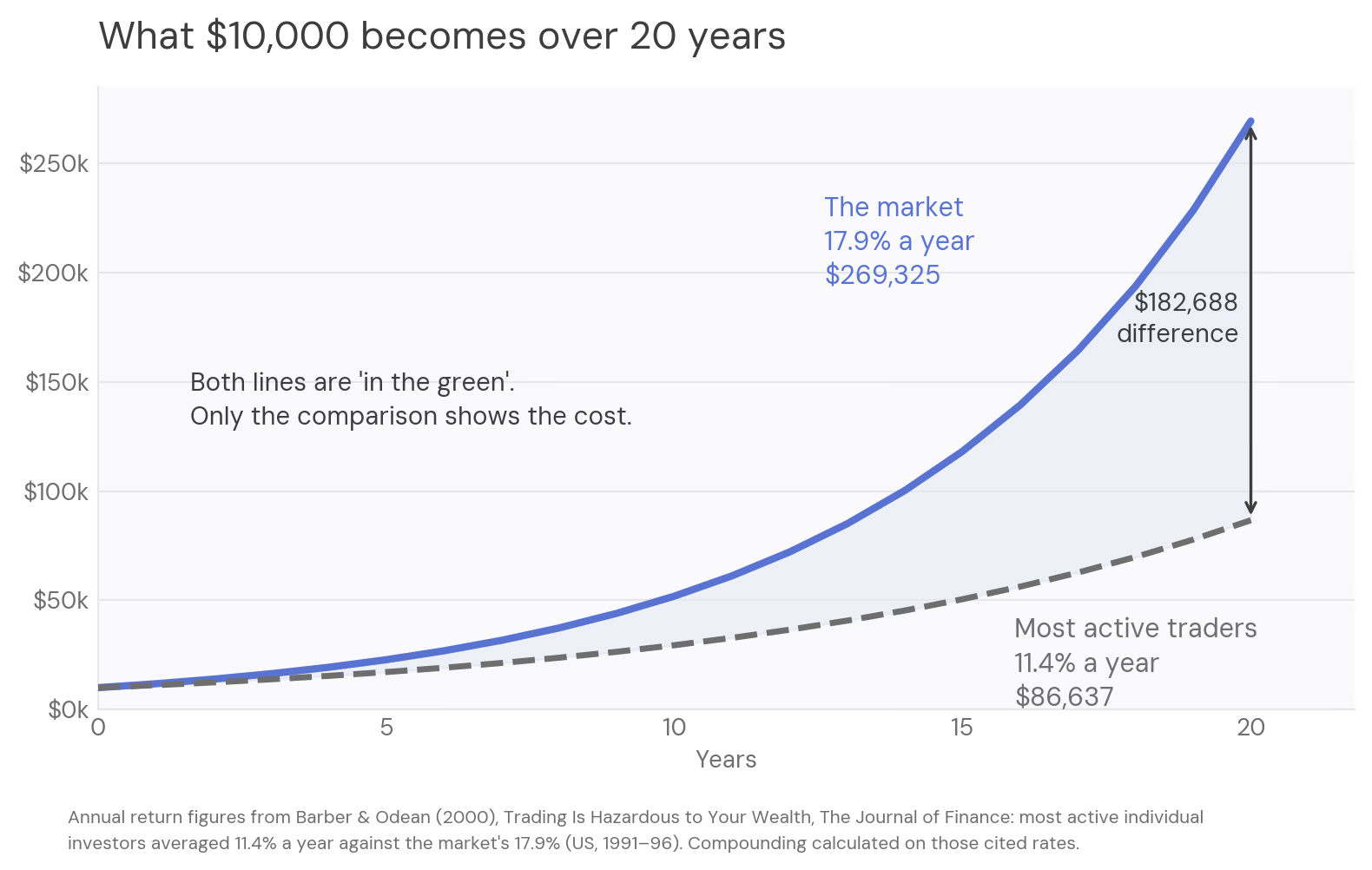
Notice what those numbers hide: the heavy traders were still going up. In the study's sample, the most active traders averaged 11.4 percent a year while the market returned 17.9 percent(6). An 11 percent year feels like winning, and the app will show it in green, but the question that matters is what the same money would have earned sitting in the index. Compounded over 20 years, $10,000 growing at 11.4 percent becomes about $87,000, while at 17.9 percent it becomes about $269,000. You can be in the green and still losing to the boring option by a house deposit, and unless you make the comparison, you will never feel it.
Carl Thompson, SortMe's founder, learned that comparison on his own money. After selling his previous company, he kept a Sharesies account for picking companies himself while the bulk of the proceeds went into professionally managed funds. "I was picking stocks because I found it fun and interesting, and my picks were returning about 14 percent, which felt great," he says. "Then I compared it with the managed funds, which were doing 22. Side by side, the two numbers ended the argument. There was no point in me doing individual trading, and the only reason I'd never noticed was that I'd never made the comparison."
His experience is the first rung of the ladder this whole article climbs: the amateur picker sits below the professionals, and the professionals, as the scoreboard shows, mostly sit below the index. The funds that beat him weren't picking winners either; his money sits in index funds and systematic portfolios run on the same Fama research cited above. Each rung up the ladder involves less picking, not more.
The apps are built to keep you doing the thing that loses. The green numbers, the notifications, the buy button one tap away, the watchlist that begs to be checked: that is the design language of a poker machine rather than a pension plan.
There's also a business model underneath the design. Trading platforms earn fees when you trade: Sharesies charges a 1.9 percent transaction fee on share orders up to a per-order cap, plus a 0.5 percent currency exchange fee on overseas trades, and Tiger Brokers charges a commission on every order(8). Revenue rises with trading activity, so the customer who buys and holds for a decade is worth far less to a trading platform than the one who trades every week. Nobody forces your finger onto the buy button, but the incentives lean on it. Buying one company's shares because they've been on a run is gambling with extra steps, and the house clips the ticket on every one of them.
What works is boring, and boring is the point
The good news is hiding inside the bad news. The strategy that beats almost every stock picker, professional or amateur, is simple, cheap and available to every Kiwi: buy a low-cost index fund and leave it there for years.
An index fund buys a tiny slice of hundreds or thousands of companies at once, so instead of betting on one company getting it right, you're backing the whole market to grind upward over time, which historically it has done, even through the crashes. No single company's collapse can wipe you out, and there is nothing to second-guess. NZ providers like Kernel and Simplicity are built entirely around this idea, and Sharesies itself started there: when it launched in 2017 the platform offered funds only, and buying individual companies only became possible two years later, once it joined the NZX in mid-2019(9). The evidence was baked into the original design, and the funds still sit alongside the trading screen today, with no Sharesies transaction fee on managed fund orders(8), so the better tool is often already in the app you have.
Choosing the fund is the easy half. The discipline is leaving it alone, because time in the market beats timing the market, and the investor who checks least usually wins.
Where SortMe fits
The reason most people can't leave their investments alone is that they can't see them properly. Your KiwiSaver sits in one app, your index funds in another, your savings in a third, and the only thing that gives you a quick hit is refreshing a single share price.
SortMe puts the whole picture in one view: KiwiSaver, investments, savings, property and your full net worth, so the number you're watching is the one that matters, your total wealth growing over years, and the comparison Carl only made after selling a company is on screen for every household from day one. "The people who do best in SortMe are watching their whole net worth, not a single ticker," he says. "Once you can see everything in one place, the urge to gamble on one company mostly disappears."
When you can see the long game, the short one loses its grip. Connect your accounts, look at the whole picture, and give your money a job that doesn't need daily checking. Setting it up takes about ten minutes.
This article is general information, not personalised financial advice. Index funds can fall as well as rise, and what's right depends on your own situation. If you want advice for your circumstances, talk to a licensed financial adviser.
Sources
- S&P Dow Jones Indices, SPIVA U.S. Scorecard, Year-End 2024 — spglobal.com: 65% of large-cap funds underperformed the S&P 500 over 1 year; 84.34% over 10 years; 89.50% over 15 years.
- William F. Sharpe (1991), The Arithmetic of Active Management, Financial Analysts Journal — stanford.edu
- Eugene F. Fama and Kenneth R. French (2010), Luck versus Skill in the Cross-Section of Mutual Fund Returns, The Journal of Finance 65(5) — onlinelibrary.wiley.com
- S&P Dow Jones Indices, U.S. Persistence Scorecard — spglobal.com: no top-quartile fund of 2020 remained top-quartile through 2024.
- Eugene F. Fama (1970), Efficient Capital Markets: A Review of Theory and Empirical Work, The Journal of Finance 25(2) — onlinelibrary.wiley.com; and FMC Act guidance, Financial Markets Authority — fma.govt.nz: insider trading is prohibited under Part 5 of the Financial Markets Conduct Act 2013.
- Brad M. Barber and Terrance Odean (2000), Trading Is Hazardous to Your Wealth: The Common Stock Investment Performance of Individual Investors, The Journal of Finance 55(2) — onlinelibrary.wiley.com: the most active traders averaged 11.4% annual returns against a market return of 17.9% over the 1991–96 sample. The in-article chart compounds these two cited rates over 20 years.
- Brad M. Barber, Yi-Tsung Lee, Yu-Jane Liu and Terrance Odean, Do Individual Day Traders Make Money? Evidence from Taiwan — berkeley.edu: fewer than 1% of day traders earn predictable positive returns after costs.
- Sharesies pricing — sharesies.nz (1.9% transaction fee per share order, capped per order; 0.5% currency exchange fee; no transaction fee on managed fund orders; checked 24 August 2026) and Tiger Brokers NZ commissions — itiger.com (USD 2 flat fee per US trade up to 200 shares; NZX 0.1% commission plus 0.2% platform fee, minimums apply; checked 24 August 2026).
- Idealog (June 2019), Sharesies investment platform is joining the NZX — idealog.co.nz, and Sharesies accredited as NZX trading and clearing participant, NZX — nzx.com: Sharesies launched in 2017 offering funds and ETFs only; access to individual NZX main-board companies arrived mid-2019.
Carl Thompson's personal return figures (14% and 22%) are his own account of his own portfolios, quoted with his approval, and are not independently verifiable claims. The description of his portfolio (index funds and systematic portfolios built on Fama's research) reflects his holdings as shared 24 August 2026: Dimensional global and Australian sustainability funds (systematic, built on Fama-French research), Harbour Sustainable NZ Shares (passive with screens), iShares MSCI EM SRI (index ETF) and Vanguard Ethically Conscious International Shares Index.