6 min read
Track every mortgage split in one place, and see the date you'll be mortgage-free

Article by
Carl Thompson · CEO and Co-founder of SortMe

Your banking app can tell you what you owe on each part of your mortgage, and very little else. Since ANZ, ASB and BNZ moved their connections onto open banking, the data feed that money apps rely on no longer includes the interest rate, whether a split is fixed or floating, or the date the fixed term ends(1). Surprise, surprise, the banks provided the absolute bare minimum data they were forced to provide.
If your loan is split three ways at one bank, that leaves you with three balances, no rates, no end dates, and no answer to the question most people want answered, which is when the whole thing will be paid off.
SortMe's new mortgage management puts those details back for each split and turns them into a forecast. Later in this article we've worked through an example where an extra $200 a fortnight takes two and a half years off a $460,000 mortgage, and shown what that does to the interest.
Why your mortgage shows up as a bare balance
Under the old screen-scraped connections, the big banks sent each loan's rate, its type, the fixed-term end date and the repayment schedule along with the balance. The open banking standard the banks now use has no field for any of it, and Akahu, the open banking provider SortMe connects through, confirms that loan details are not available on official connections(1).
Some smaller lenders, including TSB, SBS, Heartland and The Co-operative Bank, never sent those details at all. As more banks move to open banking, more mortgages will arrive in money apps as a balance and a list of transactions.
Most mortgages are several accounts rather than one. It's common to have anywhere from two to seven home-loan accounts at the same bank, each with its own rate and its own fixed term ending on its own date, so a missing rate and end date is missing several times over.
Each split tracked on its own
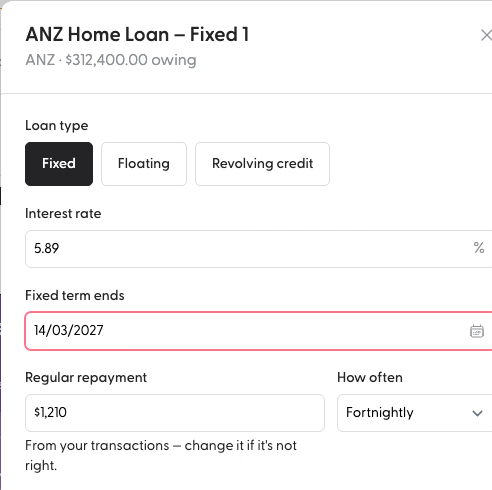
On Growth > Mortgage, every home-loan account now has its own entry. Each one shows the balance and the terms for that split: whether it's fixed, floating or revolving credit, the interest rate, the date the fixed term ends, and the regular repayment and how often you make it.
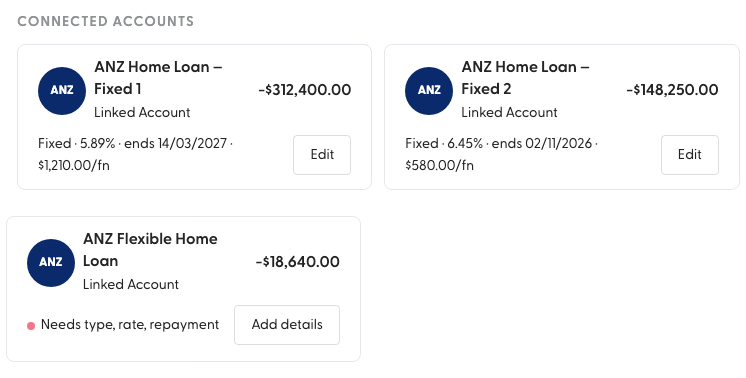
You enter those once, from your loan documents or the loan details screen in your banking app, and SortMe keeps them through every bank sync. When you refix, you update that split's details. The same editor opens from Settings > Bank Connections, and if you share SortMe with a partner, you both see and edit the same details.
If some splits are still missing a rate or a repayment, SortMe tells you how many and takes you straight to the first incomplete one.
When it's paid off, and what it costs to get there
Above the list of splits, the Mortgage forecast shows your balance falling over time, the month the mortgage is projected to be paid off, the interest still to pay, the total still to pay, and which fixed term ends next.
Take a mortgage of $460,650 split two ways: $312,400 fixed at 5.89% with repayments of $1,210 a fortnight, and $148,250 fixed at 6.45% with repayments of $580 a fortnight. On those numbers SortMe projects the mortgage is paid off in May 2042, with $244,827 of interest still to pay and $705,477 to pay in total.
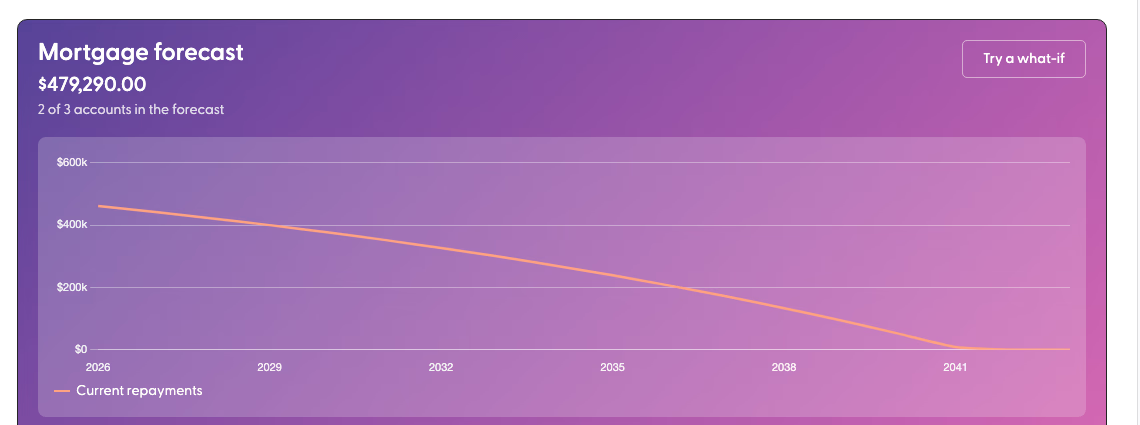
The forecast assumes that when a fixed term ends, the same rate carries on, and it says so on screen. If a repayment doesn't cover the interest on a split, the forecast tells you that balance isn't reducing instead of showing a payoff date.
A revolving credit account is different, since its balance moves with your spending and has no payoff date of its own. It counts in your total balance but has no curve. If your whole mortgage is revolving credit, the forecast has less to tell you and the refix reminders below are the more useful part.
Trying a what-if
Under the forecast, Try a what-if starts from today's numbers and lets you change three things: your repayments each fortnight, the interest rate, and a one-off lump sum on a date you choose. A table shows Now, What-if and the change between them, and a dashed line appears on the chart. Nothing is saved, so you can try as many as you like.
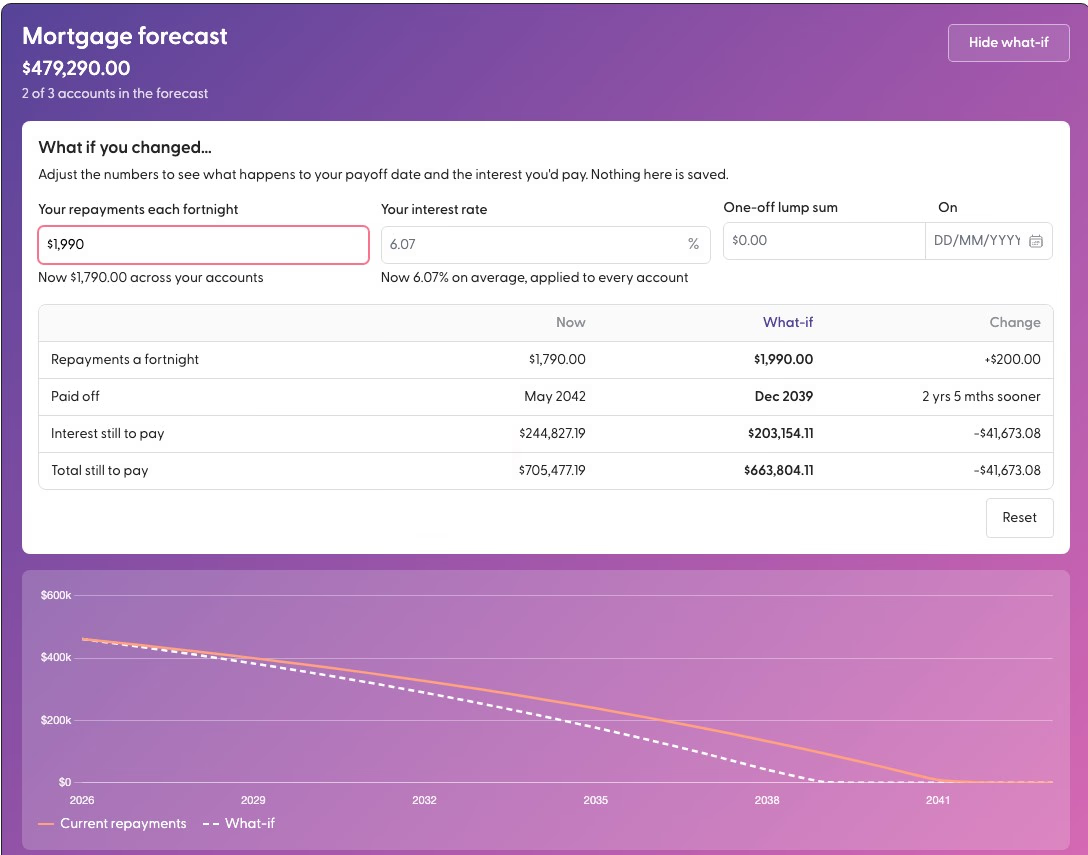
The rate gets most of the attention at refix time. I'd give the repayment just as much thought. Your bank sets a repayment that clears the loan over the full term, and anything faster than that is up to you, so the what-if is where you find out what faster is worth.
A reminder for each split before its fixed term ends
When any split has a fixed term ending in the next 90 days, SortMe shows a reminder naming that split, its balance, its rate and the date the term ends, and sends you an email about it. Dismissing the reminder for one split doesn't silence the next one, so a loan with terms ending in March and September gets a reminder for each.
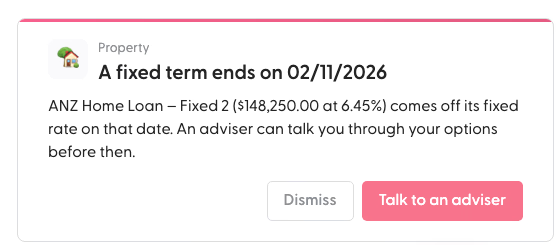
That 90 days is the time to compare rates and decide how to split the next term. If you want help with it, the reminder can connect you with a mortgage adviser SortMe works with. Our article on refixing or refinancing when your fixed rate ends covers the options in more detail.
You can also ask SortMe AI questions like "when will my mortgage be paid off?" or "which split ends next?". It answers from the details you've entered for each split, tells you if any are missing, and treats the forecast as a projection.
What $200 a fortnight does
Back to the $460,650 mortgage. Adding $200 a fortnight to the repayments brings the projected payoff from May 2042 forward to December 2039, and cuts the interest still to pay by about $41,700.
That's $5,200 a year more going onto the loan, in exchange for two and a half fewer years of repayments and around $41,700 kept rather than paid to the bank. Whether that's the right move depends on what else the money is for. If you're planning a house move or a stretch on one income in the next few years, keeping the money somewhere you can reach it may suit you better, and the what-if lets you see the trade on your own numbers before you decide.
To start, open Growth > Mortgage and add the terms for each split. Have your latest loan statement or your bank app's loan details open while you do it. Mortgage management is part of SortMe Boost, and you can try it for $1 for 7 days.
Sources
- Akahu, Official Open Banking: feature support, account information. Loan details (rate, rate type, expiry, repayment) are not supported by the open banking standards and are not available on official connections — developers.akahu.nz.